Moon phases and lunar diet

Lunar phases, moon diet, lunar calendar, info about the moon and the celestial bodies, astronomy and astrology.

Solar wind at the moment  measured by ACE

Solar wind at the moment measured by ACE

ACE is a space laboratory, studied the energy particles in the solar wind.

Advanced Composition Explorer

ACE - Advanced Composition Explorer

Data from observations of laboratory spacecraft ACE, explores energy particles in the solar wind are used for estimates of magnetic storms and geomagnetic disturbances on Earth. The measurements are very useful for studying the structure of the sun.

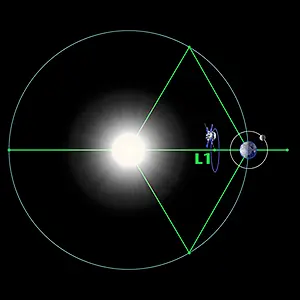
Space Observatory ACE is positioned in the first Lagrange point (L1), so that it is constant in proper position without spending much fuel. L1 point is 45 minutes before the Earth under normal conditions of space wind.

Solar wind at the moment

Solar wind at the moment (NOAA)

Solar Wind Density

Solar Wind Density

Number of protons from the solar wind per unit volume measured by ACE through SWEPAM. (Measured)

Solar Wind Speed

Solar Wind Speed

Average speed of protons from the solar wind measured by ACE / SWEPAM. Same as the speed of air molecules, known as "wind speed" of the Earth surface. (Measured)

Solar Wind Pressure

Solar Wind Pressure

Hydraulic pressure of the solar wind is the force per unit area required to stop the solar wind flow. This is similar in concept to the force a surface wind exerts on a sail. The solar wind ram pressure depends on the solar wind speed and density. (Derived)

Solar Wind Temperature

Solar Wind Temperature

The temperature of protons in the solar wind. It is measured by ACE/SWEPAM.(Measured)

Interplanetary Magnetic Field Magnitude

Interplanetary Magnetic Field Magnitude

The strength of the interplanetary magnetic field (IMF) as measured by the ACE Magnetometer (MAG). (Measured)

Interplanetary Magnetic Field Polar Angle

Interplanetary Magnetic Field Polar Angle

The angle between the IMF and the geomagnetic axis. When the IMF is southward, antiparallel fields near the magnetospheric subsolar point allow merging between the IMF and geomagnetic fields. This process increases the transport of solar wind mass, momentum, and energy into the Earth's magnetosphere. This process can also open the magnetosphere to solar energetic particle radiation. In severe conditions this radiation can threaten high altitude aircraft in high latitude and polar regions. Under less severe conditions this radiation can still threaten polar orbiting spacecraft. This quantity depends on IMF components measured by ACE/MAG. (Derived)

Interplanetary Magnetic Field Azimuth

Interplanetary Magnetic Field Azimuth

The direction of the IMF perpendicular to the geomagnetic axis. This affects the details of solar wind-magnetosphere interactions; however, this is of tertiary importance compared to the IMF magnitude and polar angle. This quantity also depends on IMF components measured by ACE/MAG. (Derived)

Voltage Across the Polar Cap and Convection Potential

Voltage Across the Polar Cap and Convection Potential

The solar wind energy input to the magnetosphere that drives magnetospheric convection. It appears as an electric potential imposed across the polar ionosphere. The quantity shown here is an estimate of the asymptotic convection potential based on ACE/SWEPAM and ACE/MAG measurements as well as the work of Boyle, et al. (Journal of Geophysical Research 102, 111, 1997.) This estimate is asymptotic because it does not account for the time delays such as those imposed by friction between the ionosphere and the neutral atmosphere.

--
Източници:
Advanced Composition Explorer Homepage, Rice Space Institute и NOAA SWPC.