SOHO - Solar and Heliospheric Observatory
Measurements of the space observatory SOHO for magnetic radiations of the sun at the moment and the state of the heliosphere.
Laboratory spacecraft SOHO, provides data in almost real time on solar activity, which is used as the primary source of prediction of magnetic storms and space weather.

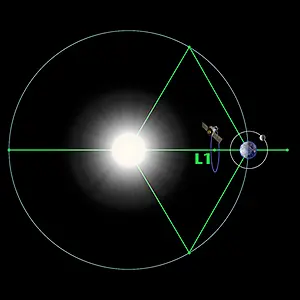
Space observatory SOHO is positioned around the first Lagrangian point (L1) in gravitational balance between earth and sun. L1 point is 45 minutes before the Earth under normal conditions of space wind.
304 EIT images the solar atmosphere at several wavelengths, and therefore, shows solar material at different temperatures. In the images taken at 304 Angstrom the bright material is at 60,000 to 80,000 degrees Kelvin. The hotter the temperature, the higher you look in the solar atmosphere.
171 EIT images the solar atmosphere at several wavelengths, and therefore, shows solar material at different temperatures. In the images taken at 171 Angstrom the bright material is at 1 million degrees. The hotter the temperature, the higher you look in the solar atmosphere.
195 EIT images the solar atmosphere at several wavelengths, and therefore, shows solar material at different temperatures. In the images taken at 195 Angstrom the bright material is at 1.5 million degrees. The hotter the temperature, the higher you look in the solar atmosphere.
284 EIT images the solar atmosphere at several wavelengths, and therefore, shows solar material at different temperatures. In the images taken at 284 Angstrom the bright material is at 2 million degrees. The hotter the temperature, the higher you look in the solar atmosphere.
MDI images shown here are taken in the continuum near the Ni I 6768 Angstrom line. The most prominent features are the sunspots. This is very much how the Sun looks like in the visible range of the spectrum (for example, looking at it using special "eclipse" glasses).
Magnetogram image shows the magnetic field in the solar photosphere, with black and white indicating opposite polarities.
LASCO(Wide spectrometry coronagraphy) captures the solar corona by blocking the light coming directly from the sun with shade disk. Creating an artificial solar eclipse in the instrument. The position of the solar disk is shown in photos with a white circle.
The most notable features of the corona are usually coronal radiance, almost radial streaks that are seen in C2 and C3. Sometimes coronal eruption, throw up mass, which can be seen passing through the two areas of coronagraphy. The shadow from the center to the lower left corner of the image is the mainstay of the dimming disk.
C2 images showing the inner solar corona at distances up to 8.4 million kilometers from the Sun.
C3 images have a greater field of vision. They include 32 solar diameters. For a better idea for this in perspective, the diameter of the image is 45 million kilometers away from the sun or half the diameter of the orbit of Mercury. Many bright stars can be seen behind the Sun.
--
Source:
SOHO interactive browser by Kristian Pontoppidan Larsen / Denmark
on Solar and Heliospheric Observatory Homepage @ NASA.