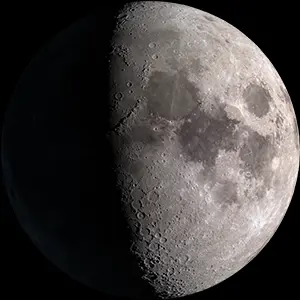
Waxing Gibbous MoonImage credit: NASA/Goddard Space Flight Center Scientific Visualization Studio.(large image)
Waxing Gibbous in Sagittarius
Waxing Gibbous on . The illuminated surface of the moon is 66% and growing larger. The lunar cycle is 9 days young.
Moonrise and moonset
The moon rises in the afternoon and sets after midnight to early morning. It is visible to the southeast in early evening and it is up for most of the night.
Moon phases on nearby dates
Slide horizontally to discover the moon phase on nearby dates.
Moon is passing about ∠15° of ♐ Sagittarius tropical zodiac sector.
1 day after First Quarter
Previous main lunar phase is the First Quarter before 1 day on 18 August 2067 at 01:09.
Sturgeon Moon after 5 days
Next Full Moon is the Sturgeon Moon of August 2067 after 5 days on 24 August 2067 at 16:57.
Neap tide
There is low ocean tide on this date. Sun and Moon gravitational forces are not aligned, but meet at big angle, so their combined tidal force is weak.
Apparent angular diameter ∠1922"
Lunar disc appears visually 1.4% wider than solar disc. Moon and Sun apparent angular diameters are ∠1922" and ∠1896".
Lunation 836 / 1789
The Moon is 9 days young and navigating from the first to the middle part of the current synodic month. This is lunation 836 of Meeus index or 1789 from Brown series.
The length of this lunation is 29 days, 15 hours and 32 minutes and it is 13 minutes longer than the upcoming lunation's length. This is the year's longest synodic month of 2067. The lengths of the following synodic months are going to decrease with the lunar orbit true anomaly getting closer to the value it has at the point of New Moon at perigee (∠0° or ∠360°).
Lunation length longer than mean
The length of the current synodic month is 2 hours and 48 minutes longer than the mean synodic month length. It is 4 hours and 15 minutes shorter compared to 21st century's longest synodic month length.
Lunar orbit details for
True anomaly ∠183°
The true anomaly of the Moon orbit at the beginning of this lunation cycle is ∠183° and at the beginning of the next lunar synodic month the true anomaly is going to be ∠207.1°.
Moon before perigee
9 days since point of apogee on 9 August 2067 at 18:29 in ♌ Leo the lunar orbit is getting narrow while the Moon is moving towards the Earth. It will keep this direction over the next 4 days until the Moon reaches the point of next perigee on 24 August 2067 at 03:23 in ♒ Aquarius.
The Moon is 372 869 km(231 690 mi) away from Earth and getting closer over the next 4 days until the point perigee when Earth-Moon distance is going to be 357 474 km(222 124 mi).
Moon in ascending node
Moon is in ascending node in ♐ Sagittarius at 17:42 crossing the ecliptic from South to North. Lunar position remains north of if for the upcoming 12 days until Moon's next descending node later on 1 September 2067 at 06:54 in ♊ Gemini.
At 18:29 the Moon is meeting its standstill point to reach South declination of ∠-22.875°. Over the upcoming 12 days the lunar orbit is going to tilt northward to face maximum declination of ∠22.778° at the point of next northern standstill in ♊ Gemini on 1 September 2067 at 09:55.
At 17:42 in the point ot ascending node the Moon is completing the last draconic month and is entering a new one while the lunar orbit is crossing the ecliptic from South to North.
In 5 days on 24 August 2067 at 16:57 in ♒ Aquarius the Moon is going to be in a Full Moon geocentric opposition with the Sun and thus forming the next Sun-Earth-Moon syzygy alignment.