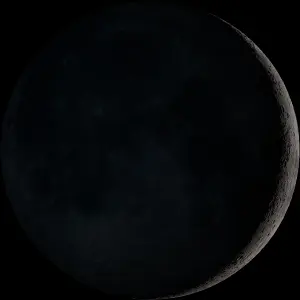
Moon is passing about ∠13° of ♎ Libra tropical zodiac sector.
Hunter Moon after 14 days
Next Full Moon is the Hunter Moon of October 2087 after 14 days on 12 October 2087 at 02:14.
Spring tide
There is high New Moon ocean tide on this date. Combined Sun and Moon gravitational tidal force working on Earth is strong, because of the Sun-Moon-Earth syzygy alignment.
Apparent angular diameter
Lunar disc is not visible from Earth. Moon and Sun apparent angular diameters are ∠1792" and ∠1915".
New lunation 1085 / 2038
At 18:47 on this date the Moon completes the old and enters a new synodic month with lunation 1085 of Meeus index or lunation 2038 from Brown series.
The length of the lunation is 29 days, 16 hours and 43 minutes. It is 2 hours and 11 minutes shorter than the next lunation's length. The lengths of the following synodic months are going to increase with the lunar orbit true anomaly getting closer to the value it has at the point of New Moon at apogee (∠180°).
Lunation length longer than mean
The length of the current synodic month is 3 hours and 59 minutes longer than the mean synodic month length. It is 3 hours and 4 minutes shorter compared to 21st century's longest synodic month length.
Lunar orbit details for
True anomaly ∠129.7°
The true anomaly of the Moon orbit is ∠129.7° and at the beginning of the next lunar synodic month the true anomaly is going to be ∠158.4°.
Moon before apogee
12 days since point of perigee on 15 September 2087 at 08:02 in ♈ Aries the lunar orbit is getting widen while the Moon is moving away from the Earth. It will keep this direction over the next 3 days until the Moon reaches the point of next apogee on 1 October 2087 at 05:52 in ♏ Scorpio.
The Moon is 399 982 km(248 537 mi) away from Earth and getting further over the next 3 days until the point apogee when Earth-Moon distance is going to be 405 480 km(251 954 mi).
Moon before ascending node
10 days after descending node on 16 September 2087 at 15:01 in ♉ Taurus the Moon is positioned south of the ecliptic over the following 2 days until the lunar crosses the ecliptic again from South to North in ascending node on 30 September 2087 at 07:30 in ♏ Scorpio.
8 days since the last northern standstill on 18 September 2087 at 21:42 in ♊ Gemini when the Moon has reached North declination of ∠20.239° the lunar orbit is extending southward over the next 5 days to face maximum declination of ∠-20.134° at the point of next southern standstill on 3 October 2087 at 03:05 in ♐ Sagittarius.